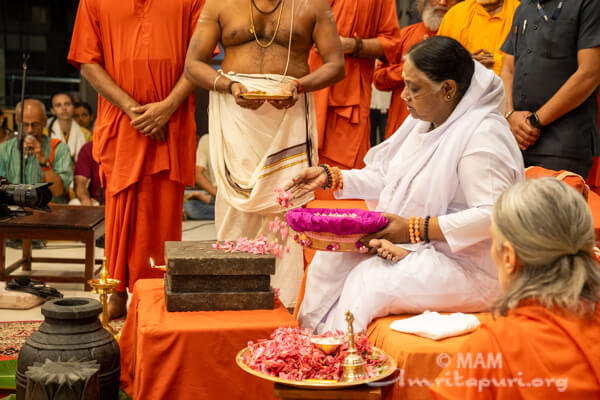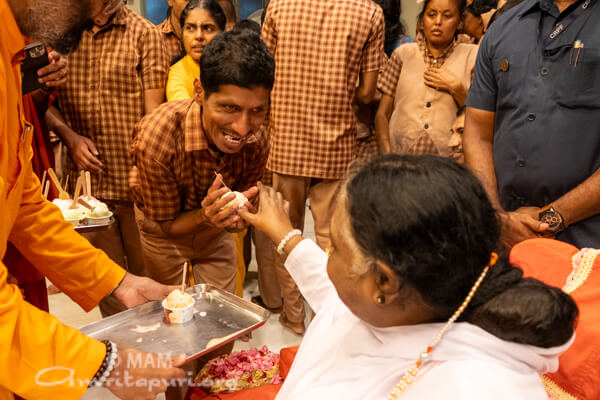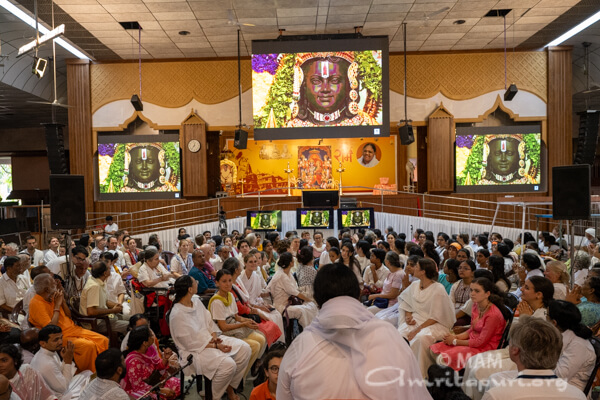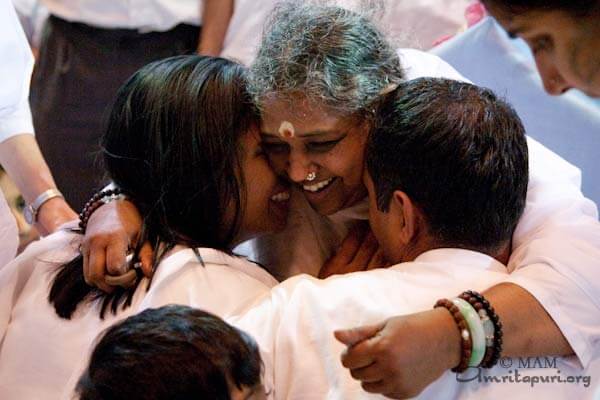
Amma's Onam
Onam 2005 — Amritapuri
When a leading Malayalam newspaper reporter
from Kerala recently asked Amma to tell him about
her Onam memories of long ago, an unforgettable
satsang poured forth. In talking about Onam and
the village life of her youth, Amma found the perfect
medium to share her vision of life, a vision wherein
every day is a celebration.
[Onam is a special festival
of Kerala. Read
about Onam.]
Living the Principle
"In my vision, every day is Onam.
"In
this village, the houses are very close together,
so the children would go to the neighbouring
houses in the evening to play, and then they
might eat dinner and sleep there itself. Whether
it was a boy or a girl, their mother wouldn't
worry because she knew her child was safe. |
 |
"When someone visited your house, you would feed
them. When you visited their house, they would feed
you. There was no such thing as waiting for the guest
to leave before eating. There was no need for matchboxes—we
would take fire for lighting the kitchen stove from
whoever nearby had it already burning. Similarly, when
they lit the deepam for the evening prayers,
they would light it using the fire from a neighbour's
house. That's they way it was.
"Even if a stranger came to the house, he would
be provided with accommodation. If it were a small
house, they would somehow find space for him in a storeroom
or by the cowshed.
"Dharma and love—through these everything
was provided in
my youth.
"On Onam, people would buy and wear new
clothes. Normally, they would have fish every day for
lunch, but on Onam they would not fish. They would
have payasam and more vegetable curries. This
is back then, not now.
"Drumstick [the pod from the Moringa tree] was
a specialty. Every house used to have a drumstick tree,
so they would have that every day… but only on Onam
would they buy extra vegetables and make special curries.
"About 50 or 60 houses from each village would
assemble in the courtyard, and they would put up a
big swing and sing songs of Mahabali, like:
"Maveli nadu vaneedam kaalam
Manushayellavarum
onnu pole
"[During the time when Mahabali
was ruling the country all of humankind
lived as one.]
"Twenty girls and boys would sit together
and sing. After the age of 12, girls were not
sent to the village shops to buy things, but
during Onam, the boys and girls would mingle
together and swing and sing and prepare the pookkalams [flower-petal
mandalas]. This was the Onam celebration.
"During the 10 days of Onam, the children
would play without getting scolded or spanked
by anyone in the family. During these 10 days,
they would have so much freedom to play and shout
and make noise. Usually the rule is that girls
should not speak loudly or run: 'If she walks,
the earth should not shake.' Boys could
run. But on these 10 days, the girls could run,
scream and shout. There was no difference between
the boys and girls. They would dance together. |
 |
"Amma doesn't think that other than these simple
traditions, the people in Amma's village understood
any principle behind Onam. Even though they were singing
the songs, they did not know the deep meaning behind
them. During the time Mahabali was ruling the country,
all of humankind lived as one... It doesn't mean
that everybody had the same height, talents, etc.—not
like that. Everyone was living their own dharma.
 |
"In my youth, whenever anyone came to
our house, my mother would serve them food. And
she would give the children the water left over
from boiling the rice, adding to it some shredded
pieces of coconut. She was worried about the
guests. Were they fed enough? Were they
happy or not? She wasn't worried whether her
children had had enough food or not. Her worry
was whether or not the guests' stomachs were
full. We would prepare tea for anyone who came
at anytime, also paan and beedis.
Make them happy and feel good. Give them all
comforts. These were the only thoughts. Even
though they didn't know the principle, they lived
the principle.
|
"Even if the people in the village were very
poor, they would buy new clothes for Onam. They would
be so happy. When they received their new set of clothes,
they would become happy in the same way that a starving
man becomes happy when he receives food. It was the
pinnacle of happiness for them.
"It wasn't only a joyful time but also a time
when they would shed their sense of 'I' and 'mine.'
The differences between the poor and the rich disappeared.
The poor would be welcomed into the rich people's houses,
and the rich would come down to the level of the poor.
They were shedding their egos, thereby transforming
themselves from small to big, from the seed to the
tree—the tree that gives shade even to the one who
is cutting it down, the tree that has patience, love
and generosity.
"During Onam, my parents would give the mooppan [the
coconut-tree climber] a new set of clothes and some
money, as well as the carpenters, the dhobis [washer-men]....
And in turn they would all bring something to my father
as well, like chunnamba [quicklime—pinches
of which are mixed with betel-nut to make paan].
"Once on Onam, Amma's brother gave clothes to
the mooppan, and he threw them to him, instead of
handing them. When the dhobis came, they would not
touch the well. You would have to give them the water.
They would not touch the well. This made Amma sad.
Amma could not understand why it was like this. Amma
would make them fetch their own water from the well.
But father's family did not like this. Now such a thing
does not exist—it was in my youth.
"They understood that in order to receive God's
grace one should serve the poor. But here untouchability
was there. Still, they served the poor because they
wanted God's grace. However, when they served the food,
they would just put it down and go away. They did not
know the principle."
The Pre-Onam Exams: Then Vs. Today
"These days, children are eager to welcome Onam,
but they also are tense because of their exams. The
Onam and exams of today are different from the Onam
and exams of yesterday. In my school days, there were
no other languages taught in third standard. English
and Hindi only came in fifth standard. A few words
of Hindi were taught in the school. Amma learned English
[the alphabet] only by looking at the calendar. At
that time there were not so many books to create tension.
"On many of the holidays, the children would
go to nearby mango trees to try to knock down the mangos.
At least six months out of the year, the backwaters
were fresh. All the children would run and jump into
the water and yell and scream. Hearing this, all the
grownups would come and beat them, but then after they
left the children would jump into the water again.
Only if our clothes were wet would our families come
to know. In villages like this, up to the age of five,
the children are not used to wearing clothes. There
was no shame in it. They had an aranjnanam [string-like
band] tied around their waist. The ones older than
that would jump in with their clothes on and then,
once in the water, they would take off their clothes,
roll them up into a ball and then throw them onto the
land. They would enjoy playing, swimming.... All the
holidays were like this—knocking down mangos and swimming
in the backwaters. Amma doesn't think the children
were very tense for the examinations in these villages.
Only a few texts were there to be studied. There was
no need to be tense."
Collecting Flowers for Making Pookkalams
"As Amma became a little older, I would
go to collect toopu [long tender stems
often used to feed goats]. There was only one
house right next to our house. After that all
the houses were surrounded by water and a little
wooded area. There would be small areas like
this around the kayal [backwater
lagoon]. In places like these, there would be
a small tree called kambatti [from which
the toopu is gathered]. I would go there to fetch
grass for the cows. Flowers used to grow around
there [which Amma would collect for making pookkalams
[the decorative flower-petal mandalas of Onam].
Then, when I was a little older, I would go east
[across the backwaters to Vallikkavu]. For a
while I studied tailoring there. I would swim
to the other shore and, holding the flowers in
my mouth, swim back." |
 |
Onam Is Not for Celebrating Only One Day a
Year
"For me, Onam is not something to be celebrated
one day a year—making sure everyone has enough food
and clothing. It is meant to be celebrated throughout
life. Everyone must make every day an Onam celebration.
Celebrating just once in a year... that doesn't mean
anything to me. To understand this principle, you have
to understand spirituality.
"Today's world believes the greatest relationship
to be the relationship between a child and its mother.
But in my world, it is not; the Guru-disciple relationship
is. Because When you understand spirituality, you understand
the principle. When you understand the principle, you
become expansive. You lose your sense of 'mine.' My mother, my father, my child, my relatives….
In the Guru-disciple relationship, everything becomes
'Yours' [the Lord's]. The 'I' disappears. Only the
Atman exists. Love and serve others as your own Self.
When the left hand is in pain, the right hand comes
and consoles it. It is with this bhava [feeling
and attitude] that we must live life. This is the principle
behind Onam.
"Two plus two is always four—never five.
No one can make it five. The sun rises in the East,
and sets in the West. It doesn't do the opposite on
Onam. So there is nothing new on Onam. Amma doesn't
feel like Onam is a special day. May people have the
mind to love and serve others and celebrate life every
day—not just on Onam. This is Amma's vision.
"You have to understand spirituality, our dharma.
The road is for traffic, but you have to follow the
rules. We are born to be happy. Along with that, you
have a dharma. The teacher has her own dharma, the
mother has her own dharma... When a teacher is at school,
she must follow the dharma of a teacher, but when she
is at home she has to follow the dharma of a mother.
Everything has its own dharma. We have to act according
to our dharma. Then the traffic of life will flow in
harmony. Whether God exists or not is not the question.
Regardless of the answer, how useful His message is
in our life! This is what we have to investigate."
We Have Lost Our Discrimination
"We need to develop the language of the heart.
But now we are only developing our intellects. When
there is a mixture of sand and sugar, the intellect
cannot distinguish between the two, but the ant can
come and take only the sugar. That's the beauty of
the heart.
"The intellect is like a pair of scissors,
cutting everything in two. People say they have grown,
but Amma doesn't see any viveka [faculty
of discriminative thinking] in them. They say they
are growing, but Amma doesn't see them expanding.
They are intelligent, but don't have viveka. They
have the information but not the bodha [awareness].
The intellect has grown, but the heart is weakening.
They have beautiful houses, but their families are
falling apart. This is the world we are living in
today. So there is no comparison between the Onam
of today and the Onam of yesterday. Today, it is
mechanical. Back then it was pulsating with life.
There was heart and beat.
Even if it was blind belief, there was a pulsation
of love at its core. They were living the
principle. Today, even though someone may know the
principle, they are not living up to it. We lost
our viveka. The intellect has grown, but our viveka
has been lost.
"Because of this lack of viveka, the distance
between family members is increasing. If there are
three members in a family, they are living like three
islands. We are not single islands; we are connected
like the links of a chain. What we show our children,
our children will emulate. If we do not look after
our parents, our children will not look after us. That
is the state we are heading towards. You get what you
give. This is the best proof for the principle of karma.
"Today there also are celebrations, but the families
go to some restaurant. In the olden days, all the children
from far off places would come to the house. They would
sing, dance, play and eat together. Not just the immediate
family's children, but all the children, mothers,
fathers etc. would come to the taravadu [ancestral
home]. Nowadays, they either eat at a restaurant or
get take out. In the olden days, they would prepare
weeks ahead, husking and pounding the rice for all
the many family members who would come."
The Relationship of Love
"I have seen my mother when she was grinding
the curry powders—the child may be a little further
away and milk would leak out from her breast and wet
her blouse. Immediately she would say, "Oh, my
child is hungry!" Maybe the child would be
in the next house. Or maybe he is with the older children.
The child is not with the mother, but she will feel
the child's needs. The breast will leak milk unceasingly.
So she will clutch her breast and say, "My child
is hungry!" And if you were to reach out to the
child, you would find that it was true. The mother
has not heard the child cry. The vibration of the child
has reached the mother, and the mother's breast is
leaking milk. This is the relationship of love.
 |
"Amma has travelled all around the world.
When she listens to people's problems, she understands
how far we have deviated from our values, how
much we have lost.
"Nowadays, people buy cards on days like
St. Valentine's Days with the words 'I love you'
written on them, but it was not necessary to
say such things in day's past. Now it is only
in the words.
"It is not the action but the attitude
that is the most important thing. In the olden
days, people had the correct attitude." |
—Sakshi
|